August 5, 2026

Wednesday

The Stink of Reluctant Progress

In today's journal

Order emerges from gridlock, a legendary flop refuses to be forgotten, and an uneasy exhale of relief arrives right on schedule.

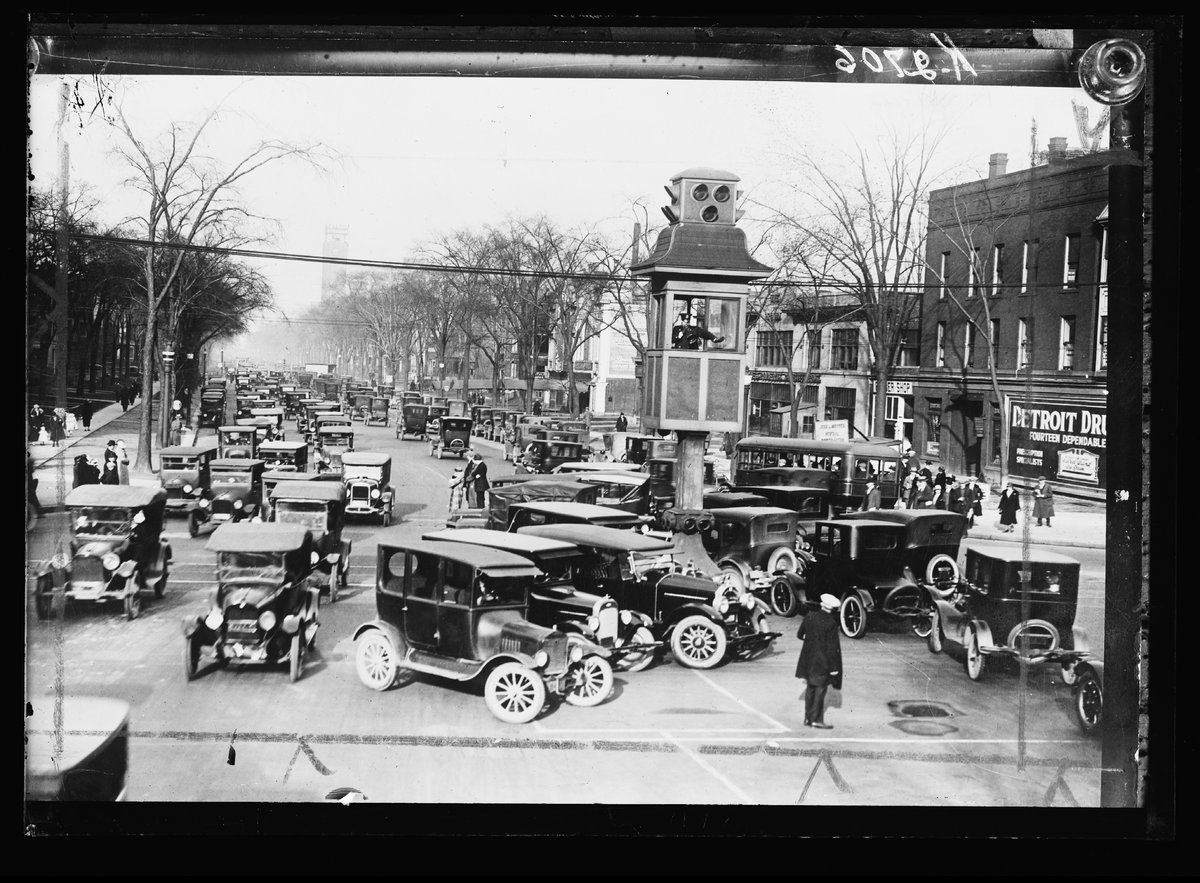
A traffic tower includes a traffic signal and a policeman directing traffic in Detroit, Michigan; Detroit Publishing Company photograph collection (Library of Congress)(public domain).

A traffic tower includes a traffic signal and a policeman directing traffic in Detroit, Michigan; Detroit Publishing Company photograph collection (Library of Congress)(public domain).

I realized that the top of the tower in today’s feature image is hard or impossible to see in some browsers (on a desktop, though it shows well on mobile), so I figured I’d post the photo in a separate post today.

All feature images force me to think about something, but today’s image really got me thinking about several things that I wanted to write about separately.

First, as a patent attorney, I’m always fascinated by visuals that show the development of a technology over time. This photograph does exactly that. It clearly shows a traffic signal with three lights (at least two sides of the tower have a three light system). And, considering the location and time of the photograph (Detroit, sometime between 1915 and 1925), it seems likely that the traffic signal in this photograph is the next generation three light signal invented and innovated in Detroit. The three light system was an improvement on the two light system first installed in Cleveland on this day in 1914 .

Progress.

Second, seeing the policeman standing in the tower (with a megaphone, btw) caused me to think about a theme that is oft-repeated with the introduction of new technologies: displacement of human workers and jobs. I’ve thought about that issue in connection with seemingly more complicated technology, but never considered the lowly traffic signal as a job killer. Was it one?

Wikipedia is helpful on this question:

By 1922, traffic towers were being controlled by automatic timers more widely. The main advantage of using the timer was that it saved cities money by replacing traffic officers. New York City was able to reassign all but 500 of its 6,000 officers working on the traffic squad, saving the city $12,500,000.

(unfortunately, the full paper cited for that point, The Origins and Globalization of Traffic Control Signals by historian Clay McShane, is not available online)

It seems, then, that the wide adoption of automatic traffic signals did eliminate human jobs, even though most affected workers in New York were “reassigned”. The main driver of that adoption, unsurprisingly, was money.

Third, I think this photo does a nice job of visually illustrating a reality that frequently accompanies the introduction of new technology. On the surface, everything around the technology appears a bit chaotic. Deeper consideration, though, often reveals advantages of the technology that might be hiding in plain sight. For example, the traffic in this photo, at first glance, seems to be completely snarled. Taking time to look closer, though, you begin to see the order of everything, with the traffic light standing tall above it all. The policeman, also above the fray, is barking orders at someone, but, overall, everything seems to be running fairly smoothly. Indeed, a visual walk around the frame shows a pedestrian who must have been comfortable enough to walk into the mess at the bottom and a group of people at center-left who are literally standing in front of traffic halted by the signal. They’re standing together, calmly and patiently waiting for an opportunity to cross the street on the left, clearly comfortable with the order established by the traffic signal (and, perhaps, partly by the policeman).

And finally, how did that guy get up there?

What a great photo.

photo published in /2026/08/05 at 10:31 AM
Reference this post

Please use the direct URL below when referencing this post. If you’d like to reference this day’s page in general, use the day URL below. You can refer to me as “Matt” or “Matt Buchanan” and the site as “Some Was True”.

Speaking of technology and progress, Smell-O-Vision is one of those rare examples of a flop that has cemented a place in the collective consciousness. This Popular Science article provides a great overview of the technology, its rollout, and a competitor that also flopped but was quickly forgotten (AromaRama).

Why do we associate the brand “Smell-O-Vision” with any attempt to incorporate scents with movie theaters? The article presents a theory:

Smell-O-Vision’s abrupt turn from hype to nothingburger, and its silly name, helps explain how it lingers in pop culture. It would take a radical leap forward for scented media to outgrow its hokey origin story. So far, nobody’s done it.

I’m not sure many people remember the “abrupt turn from hype to nothingburger”, these days. For me, the “silly name” likely explains it. What a great brand.

link published in /2026/08/05 at 11:32 AM
Reference this post

Please use the direct URL below when referencing this post. If you’d like to reference this day’s page in general, use the day URL below. You can refer to me as “Matt” or “Matt Buchanan” and the site as “Some Was True”.

According to Assistant Attorney General Harmeet Dhillon, the monitors’ mandate this year was to root out “problems with the integrity of elections.” If they found any, it wasn’t immediately clear Tuesday.

[E]lection officials said monitors were polite and unobtrusive as they moved from one polling place to the next, asking a few questions about assistance technology designs for voters with disabilities and provisional ballots. Importantly, officials Votebeat spoke with on Tuesday said monitors did not interfere with election proceedings.

I hate that this brings a minor feeling of relief, but it does.

link published in /2026/08/05 at 8:15 PM
Reference this post

Please use the direct URL below when referencing this post. If you’d like to reference this day’s page in general, use the day URL below. You can refer to me as “Matt” or “Matt Buchanan” and the site as “Some Was True”.

This paper includes some truly beautiful images of our star, the sun. The images were made through observations using the world’s first 4-m class solar telescope, the US National Science Foundation’s Daniel K. Inouye Solar Telescope in Hawaii. This Yahoo! News article reporting on the paper has some incredible detail on the resolution of the telescope and an interesting analogy that really puts the optical feat into perspective:

In some of these new images, the cresting vortices that dot the sun are barely 12 miles wide. To put the achievement into perspective, the feat is like trying to discern George Washington’s face on a quarter from roughly 74 miles away. The details of the milestone achievement are detailed in a study published today in the journal Nature.

Impressive, and beautiful!

link published in /2026/08/05 at 9:14 PM
Reference this post

Please use the direct URL below when referencing this post. If you’d like to reference this day’s page in general, use the day URL below. You can refer to me as “Matt” or “Matt Buchanan” and the site as “Some Was True”.

Some Was True publishes daily observations and commentary on everything from culture and history to sports and technology. You'll probably learn something each time you visit the site. And sources will be cited. The About page has more information about the background of the site and details on how content is organized.

About today's feature image